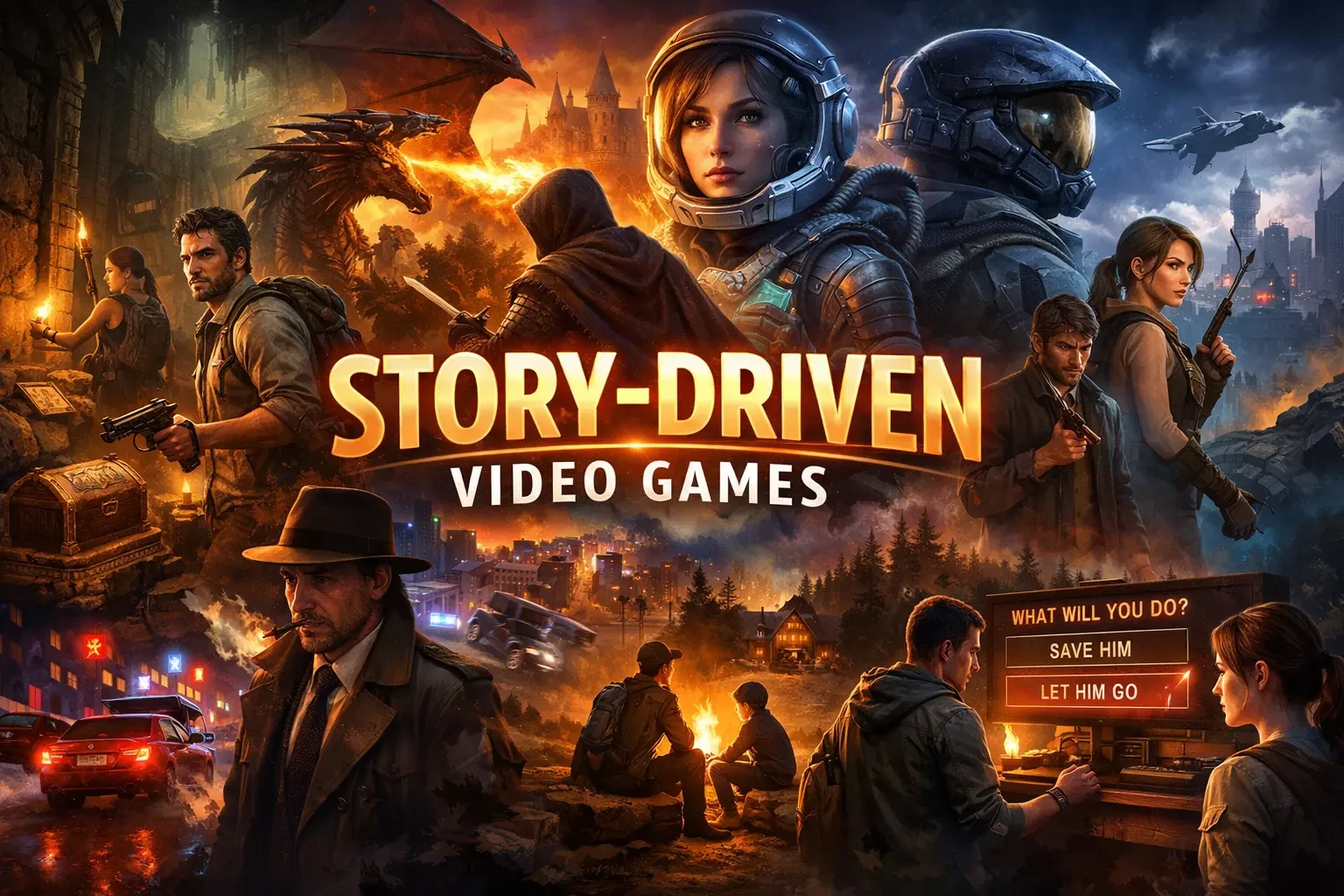
For decades, the relationship between video games and cinema has been one of mutual fascination and occasional rivalry. Early attempts to merge the two often resulted in clunky quick-time events or pixelated cutscenes that felt more like interruptions than integrations. Today, however, we are witnessing a golden age of narrative design where the line between “playing a game” and “watching a film” has become not just blurred, but deliberately dissolved. The best story-driven titles no longer merely borrow from cinematic language—they redefine it within an interactive framework, delivering emotional weight, pacing, and directorial vision that rival—and sometimes surpass—their linear counterparts.
This article explores the mechanics, design philosophies, and standout examples of games that achieve this remarkable feat. We will dissect why certain titles feel like controlled movies, how technology enables this hybrid art form, and what the future holds for players who crave both agency and spectacle.
The Pillars of Cinematic Game Design
Creating a game that feels like a movie is not about adding more cutscenes. It is a holistic approach to pacing, player agency, and environmental storytelling. Successful developers adhere to several unspoken rules that align interactive moments with narrative momentum.
1. Diegetic Interface and Minimal Disruption
The most immersive experiences hide their mechanics. Instead of cluttering the screen with health bars, minimaps, and quest trackers, modern cinematic games integrate status updates into the world itself. In God of War (2018), the Leviathan Axe’s runic symbols glow faintly to signal cooldowns. In Dead Space, the health bar is literally a spine on the protagonist’s back. This diegetic UI respects the “fourth wall” and keeps the player anchored in the drama, reducing the jarring transition between gameplay and cutscene.
2. Continuous Shot Storytelling
Perhaps the most powerful tool borrowed from auteurs is the “one-take” or long take. Directors like Alfonso Cuarón and Alejandro G. Iñárritu use unbroken shots to create inescapable tension. Hellblade: Senua’s Sacrifice and God of War employ this technique flawlessly, with zero camera cuts from the opening frame to the credits. The camera glides over the player’s shoulder, pans across environments, and seamlessly transitions into dialogue or combat without a loading screen. This creates a relentless, hypnotic flow that mimics the experience of being in a film that never pauses for a commercial break.
3. Player-Driven Emotional Pacing
Unlike linear film, a game can let the player dwell. While a movie might spend three minutes on a character’s grief via a static close-up, a game allows the player to wander through a rain-soaked village, open drawers filled with memories, and choose how long to stare at a photograph. This “grief-able” time is a unique advantage. The Last of Us Part II capitalizes on this by forcing the player to perform mundane, intimate tasks—like cleaning a guitar or feeding a horse—during moments of narrative quiet. These interactive vignettes generate a deeper, more personal connection than any passive camera angle could achieve.
Case Studies: The Masterclass of Interactive Cinema
To understand the methodology, we must examine specific titles that have set the benchmark. These are not simply “games with good stories”; they are experiential narratives where the gameplay mechanics are the plot.
| Until Dawn | Supermassive Games | Butterfly Effect & Camera Shots | Player choices permanently alter who lives/dies |
| Detroit: Become Human | Quantic Dream | Branching Flowcharts & Variable Pacing | Moral decisions with delayed consequences |
| Red Dead Redemption 2 | Rockstar Games | Slow-Cinema Realism & Natural Lighting | Unscripted NPC interactions in open world |
| Uncharted 4 | Naughty Dog | Blockbuster Action Choreography | Platforming falls that mirror film stunts |
| Disco Elysium | ZA/UM | Interior Monologue & Narration | Dialog trees that reveal psychological depth |
The “Playable Scene” Revolution
Naughty Dog’s Uncharted series, particularly the fourth installment, perfected the “playable scene.” In a typical sequence, Nathan Drake climbs a collapsing crane. In a film, this would be a thrilling 90-second special effects reel. In the game, it is a 10-minute interactive sequence where the player controls each handhold, judges the physics of swinging ropes, and reacts to environmental collapse in real time. The director’s camera angles guide the player’s eyes, but the player’s skill determines the success. This synergy transforms a passive spectacle into a personal victory.
The Psychological Contract of “Ludo-Narrative Harmony”
Critics often reference “ludo-narrative dissonance” as the failure point—when the story says one thing but the gameplay says another (e.g., a pacifist character who must murder dozens to progress). The best cinematic games strive for harmony. In Spec Ops: The Line, the disturbingly brutal white-phosphorus sequence is executed via a standard shooter mechanic, yet the narrative aftermath forces the player to confront the horror of what they just did. The act of pressing the “fire” button becomes the tragic decision. The game doesn’t show you a cutscene of remorse; it forces you to walk through the charred aftermath, with the protagonist vomiting in the background. That is pure cinematic horror, delivered via interactive responsibility.
Technical Foundations: How Engines Make Movies
The technical leap from pre-rendered CGI to real-time rendering is the backbone of this genre. Modern engines like Unreal Engine 5 and Decima render photorealistic faces, micro-gestures, and volumetric lighting in real time. This allows developers to keep the camera inside the action without breaking to a pre-scripted video file. Performance capture, pioneered by studios like with Andy Serkis’s work on Heavenly Sword and later perfected in Death Stranding, records actors’ bodies, faces, and voices simultaneously. The result is that a character’s subtle lip tremor or a flicker of hesitation in the eyes is rendered live, responsive to the player’s timing. No movie scene can do that—it is a performance that only exists because you are there to trigger it.
The Future: Branching Narratives and AI Directors
As we look ahead, the convergence deepens. The next generation of cinematic gaming will be powered by AI-driven narrative directors. Imagine a system that monitors your emotional state (via biometric feedback or playstyle) and adjusts the film score, camera angles, and NPC behavior in real time. If you are frustrated from failing a puzzle, the “director” might subtly shift the lighting to a calmer palette or change the companion dialogue to be more reassuring. Conversely, if you are playing aggressively, the score might swell with percussive urgency, and the camera will adopt a more shaky-cam, Jason Bourne-style aesthetic.
Furthermore, the rise of “episodic live-service storytelling,” as seen in Hitman: World of Assassination or the ongoing seasons of Fortnite (though not story-first), indicates a future where movies become serialized, evolving universes. Players won’t just watch a sequel; they will inhabit a continuous, mutable narrative world.
Conclusion: A New Audience, A New Author
The games that feel like movies are not trying to replace cinema. They are expanding its vocabulary. They offer something no passive medium can: the burden of choice and the joy of consequence. When you finish Red Dead Redemption 2, you don’t just remember the scenes of Arthur Morgan’s decline—you remember the hours you spent riding across the plains, the sunsets you chose to watch, the strangers you decided to save. That is the auteur’s touch extended into the player’s hands.
As technology continues to erode the boundary between simulation and reality, the title “game” becomes insufficient. These are interactive films, playable dramas, and emotive engines. For the discerning player, the medium’s greatest success is not in looking more like a movie, but in making us feel like we are the star, the director, and the camera operator all at once. The story is no longer told to you; it is performed by you.

Related Posts