
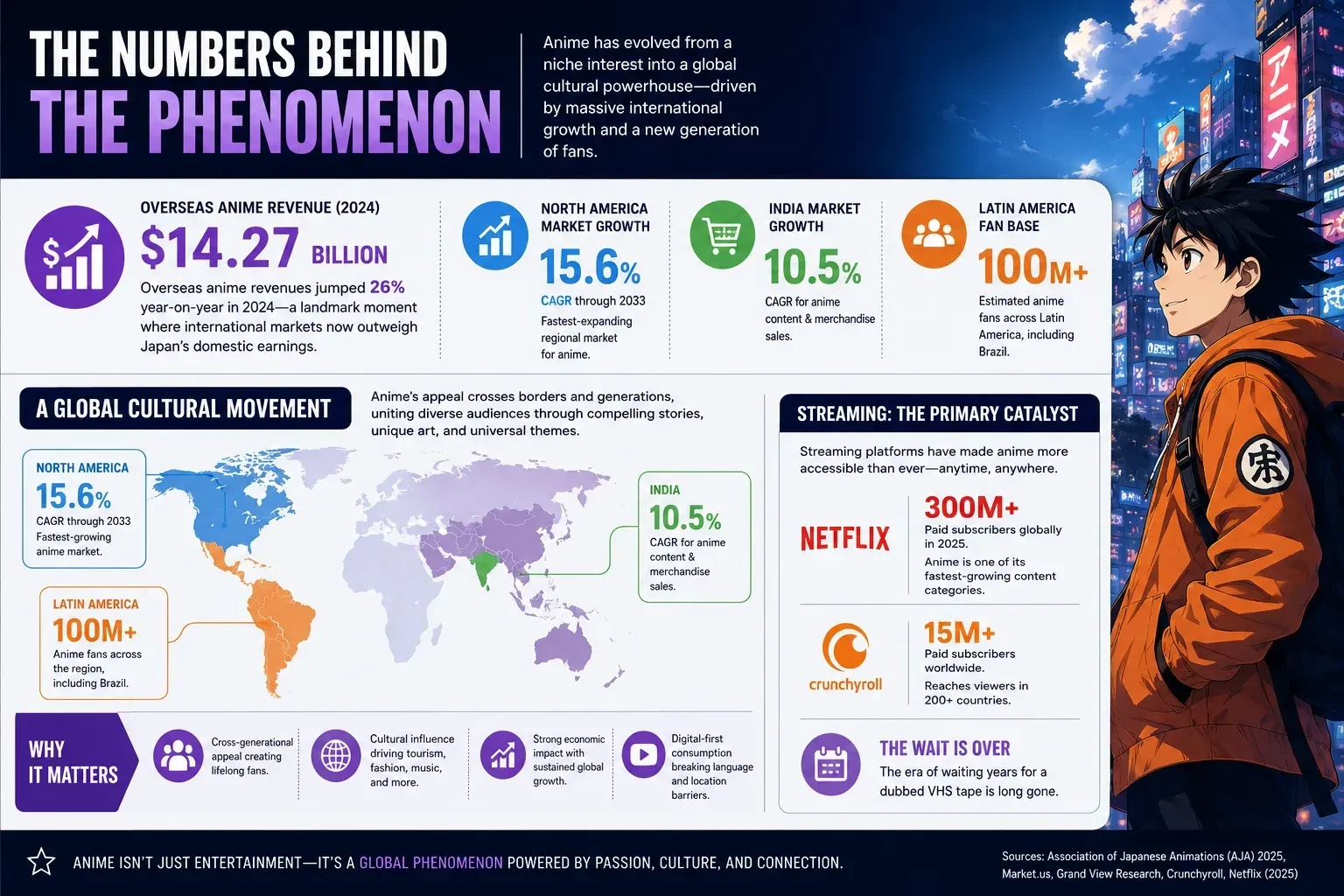
For decades, anime was often pigeonholed as a niche subculture, a curious import from Japan with a devoted but limited audience. Today, that perception is not merely outdated—it is categorically false. Anime has evolved into a dominant force in global entertainment, outpacing traditional Western animation in both cultural penetration and economic viability. The sustained, exponential growth of this medium is not an accident of streaming algorithms; it is the result of a confluence of technological infrastructure, narrative innovation, and a fundamentally different approach to intellectual property management. To understand why anime continues its global ascendancy, we must examine the pillars of its expansion: distribution democratization, narrative complexity, and a unique creator-centric production model that leverages digital tools without sacrificing artistic integrity.
The Streaming Revolution and the Collapse of Geographic Barriers
The most immediate and quantifiable driver of anime’s global growth is the radical transformation of its distribution pipeline. Prior to the 2010s, anime consumption in Western markets relied on physical media, expensive satellite channels, or fan-subbed bootlegs. This created a high-friction experience that limited growth to hardcore enthusiasts. The advent of global streaming platforms—from Crunchyroll and Funimation to Netflix and Hulu—eliminated that friction entirely. Simultaneous or near-simultaneous global releases mean that a new season premiering in Tokyo is available in São Paulo, Berlin, or Jakarta within hours.
However, the technical capability of streaming alone is insufficient. The growth is deeply tied to algorithmic curation and data-driven localization. Platforms no longer treat anime as a single, monolithic genre; they segment it into sub-categories—isekai, mecha, slice-of-life, psychological thriller—and recommend based on viewing habits. This granular approach converts casual viewers into committed fans. Furthermore, the investment in high-quality dubbing and, crucially, accurate subtitles has elevated the consumer experience. The industry has moved beyond literal translations to cultural localization, ensuring that jokes, honorifics, and contextual nuances resonate with global audiences.
The Role of Simulcasting and Pirated Content Mitigation
Legal simulcasting has successfully cannibalized the illicit download market, channeling revenue back into production studios. The speed at which content is made available legally has shifted the moral calculus for consumers. Instead of waiting months for a physical release, fans pay a monthly subscription for immediate access. This economic model creates a stable revenue stream independent of box office performance, allowing studios to take creative risks. As a result, the volume of anime produced annually has surged, creating a self-reinforcing loop: more content attracts more viewers, more viewers generate more subscription revenue, and that revenue funds more ambitious projects.
Narrative Maturity and Serialized Complexity
While technology enables distribution, the content itself provides the retention. Unlike the episodic, often reset-based narrative structure of Western children’s animation, anime predominantly operates on serialized, long-form storytelling. Shows like Attack on Titan, Fullmetal Alchemist, or Vinland Saga do not merely entertain; they demand intellectual engagement. They tackle philosophical dilemmas—the ethics of war, the nature of identity, the consequences of unchecked ambition—with a maturity that has historically been lacking in Western animated media.
This narrative complexity appeals to a demographic that streaming data repeatedly confirms: adults aged 18-34. This audience is not looking for disposable content; they are looking for emotional investment and intellectual rigor. Anime offers something that live-action often cannot: the freedom to explore fantastical worlds without the constraints of visual effects budgets. A writer can conceive of a city-sized battle, a galaxy-spanning political conflict, or a deeply intimate psychological journey without the producer worrying about the cost of a CGI explosion.
The Isekai Phenomenon and Escapist Economics
A significant sub-segment driving recent growth is the isekai genre (stories of characters transported to another world). While often dismissed by critics as formulaic, its prevalence speaks to a profound global sentiment. In an era marked by economic uncertainty and social isolation, isekai provides a structured, predictable escape where the protagonist is often rewarded for mundane competence. This is not merely a Japanese cultural artifact; it is a global psychological response to systemic pressures. The relentless output of this genre, fueled by a vast library of light novels being adapted at unprecedented pace, creates a weekly cadence of new content that keeps subscribers engaged and social media algorithms buzzing with discourse.
The Creator-Centric Production Pipeline and Global Talent Acquisition
Perhaps the most underappreciated factor in anime’s growth is the structural evolution of its production ecosystem. Japan’s animation studios have transitioned from insular, unionized hierarchies to more fluid, digitally integrated networks. The use of cloud-based animation tools and remote collaboration platforms has allowed studios to hire talent from across the globe—colorists from the Philippines, keyframe animators from France, and background artists from Canada. This influx of diverse perspectives enriches the visual language of anime while keeping production costs manageable.
Moreover, the success of co-productions (such as Cyberpunk: Edgerunners with CD Projekt Red) has proven that anime is not a closed cultural system. Western creators are increasingly seeking out anime studios for their unique aesthetic, while Japanese studios are embracing Western IP to expand their audience base. This symbiotic relationship has led to a cross-pollination of ideas, where genres are hybridized, and the definition of “anime” itself becomes more fluid, encompassing CG-heavy productions and hybrid 2D/3D techniques that push the visual envelope.
Data-Driven Merchandising and the Long-Tail Economy
Anime’s financial growth extends far beyond streaming subscriptions. The merchandise and secondary IP exploitation market is a multi-billion dollar ecosystem. Here, technology has played a pivotal role in the form of direct-to-consumer platforms and blockchain-based provenance for collectibles. Unlike traditional Western franchises that rely heavily on box office and toy retail, anime monetizes through a long-tail of goods: from nendoroid figures and prize games to apparel collaborations with luxury brands (e.g., Gucci x The Simpsons, but more aggressively, anime collaborations with streetwear labels).
| Streaming Distribution | Edge caching, adaptive bitrate, AI subtitling | Global simultaneous release, reduced piracy |
| Production Efficiency | Cloud rendering pipelines, remote collaboration | Higher output volume, lower per-episode cost |
| Fan Engagement | Social media virality, fan art marketplaces | Organic marketing, community-led growth |
| Merchandising | E-commerce localization, print-on-demand | Expansion into non-traditional retail markets |
| Narrative Analytics | Viewer retention data, sentiment analysis | Targeted sequel production, genre optimization |
This data-driven approach ensures that studios do not over-produce and flood the market. They analyze which characters drive engagement, which arcs cause viewer drop-off, and then tailor the next season or film accordingly. This is a stark contrast to the “throw everything at the wall” approach of some Western streamers. The result is a highly efficient cultural export machine.
Conclusion: The Resilience of the Human Hand in a Digital Age
Anime’s continuing global growth is not a passing trend but a structural shift in the global entertainment landscape. It succeeds because it has married the efficiency of digital distribution with the irreplaceable value of human-driven artistic labor. While AI and CGI offer tools for efficiency, the core of anime—the expressive hand-drawn frames, the subtlety of a character’s blush, the timing of a dramatic pause—remains a human craft. This authenticity is a premium commodity in an age of algorithmic content generation. As long as anime studios continue to leverage technology to break barriers while refusing to compromise their narrative depth, their global dominance will not merely continue; it will accelerate. The world is watching, and the world is staying.

Related Posts